

Beach Sprints and Coastal Rowing: How the New Race Format Works
Beach sprint rowing packs a beach run, a 500-metre sea course and a sprint finish into under three minutes. Here's how the format, boats and rules work.
Beach Sprints and Coastal Rowing: How the New Race Format Works
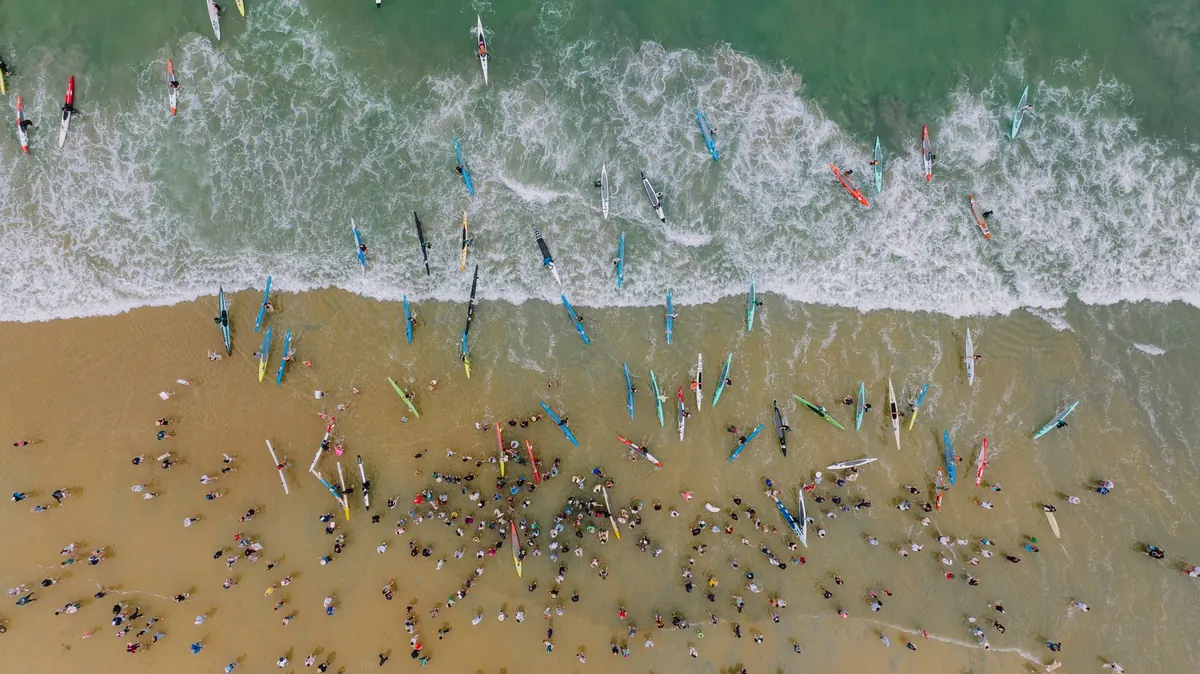
Two athletes sprint across wet sand, drop into a narrow boat their handlers are holding in the shallows, row 250 metres into open water, swing around a buoy and race back to the beach. One of them jumps out and runs to the finish line. Start to finish, the race lasts less than three minutes.
If you have only watched 2,000-metre racing on a still lake, beach sprinting looks like a different sport wearing the same kit. It is still rowing — same stroke, similar hulls — but the course, the rules and the skills that decide medals are all built around surf, sand and short, sharp efforts.
Coastal Rowing, in Plain Terms
Coastal rowing is the umbrella term for racing on open water, usually off a beach, in boats built to handle chop and salt. Two formats sit under it. Beach sprint is the short knockout version: a beach start, a course of roughly 500 metres with a buoy turn, and a run to the finish line on the sand. Endurance racing is the longer event, typically four to six kilometres over laps, also starting and finishing on the beach.
Endurance racing has its own world championships, often held on exposed coastlines where conditions change hour by hour. Boats are typically wider and more stable than flat-water shells, with self-bailing cockpits and reinforced hulls. The most common classes are the solo (C1x), double (C2x), and coxed quadruple sculls (C4x+).
Both are run internationally by World Rowing, and beach sprint is set to appear at the Los Angeles 2028 Olympic Games, with men's and women's solo events plus a mixed double sculls.
What separates coastal from classic regatta racing is simple enough. No lanes, no straight 2,000 metres, no guaranteed flat water. Wind, swell and current are part of the race, and a tidy turn can be worth more than a few seconds of raw power.
The Beach Sprint Course, Step by Step
Beach sprint heats are short enough to memorise. The sequence is broadly the same from a local club regatta to a World Rowing Beach Sprint Finals:
- Start run. Crews line up on the sand and sprint to their boat at the signal. The run is usually 10 to 20 metres, but on soft sand it can feel much longer. A fast start can unsettle a rival before the first stroke.
- Launch. Handlers hold the boat steady in the shallows; the crew gets in, gets blades in the water and rows away. Nobody is allowed to push the boat — propulsion comes from the crew. In doubles, the two rowers must coordinate their entry so the boat does not drift sideways.
- Outward leg. Around 250 metres to the turning buoy. This is a flat-out sprint, often into wind or across a side chop. Crews that can hold a long, powerful stroke without catching a crab gain precious metres.
- The turn. Round the mark in the direction the rules specify. Touching the buoy is allowed in some rulesets, but cutting inside it is not. A good turn is a tight arc: the inside rower lifts their blade, the outside rower keeps pressure, and the boat pivots without losing speed.
- Return leg. Back toward the beach, ideally riding whatever swell is running. Surf can be an ally. A crew that catches a wave can surge past a rival in seconds, but a poorly timed wave can bury the bow and stop the boat dead.
- Exit and final run. The nominated athlete leaves the boat inside the transition area and runs to the finish line on the sand. In solo events, the same athlete rows and runs. In doubles, one crew member is nominated before the race; that person must be the one who exits and crosses the line. The other rower stays with the boat.
False starts, missed buoys, and exiting the boat outside the transition area all carry penalties, usually a time addition or disqualification. The transition area is marked clearly on the beach, and handlers may help steady the boat but cannot push it forward.
What Makes a Good Beach Sprinter
Beach sprint rewards a different athlete profile from classic rowing. A 2,000-metre race is mostly aerobic; a beach sprint is a series of explosive bursts. The start run, the launch, the turn, and the final run all demand short, maximal efforts. Rowers who excel often have a background in surf lifesaving, rugby, or track sprinting.
Technique matters as much as fitness. The ability to row in choppy water with a shorter, quicker stroke is essential. A crew that tries to row a long, flat-water rhythm will often catch a blade and lose balance. Instead, successful crews keep the rate high, the blades moving, and the boat gliding over the chop rather than through it.
The turn is not a pause. It is a place to gain or lose a boat length, and the best crews treat it as another stroke in the race.
Running speed is also a factor, but not the only one. A fast runner who cannot exit the boat cleanly will lose more time than they gain. The best beach sprinters practise the transition from rowing to running until it becomes automatic: one hand on the gunwale, one foot on the sand, and a clean sprint to the line.
Equipment and Safety
Coastal boats are built for abuse. They have reinforced bows, self-bailing holes, and wider beams for stability. The most common beach sprint boat is the solo coastal single, about 5.5 metres long and 0.7 metres wide, with a weighted keel or centreboard to keep it upright in surf. Doubles are slightly longer and heavier.
Safety is a priority. Crews must wear personal flotation devices (PFDs) that meet World Rowing standards. Handlers wear helmets and high-visibility vests. Race organisers monitor wind, swell, and lightning, and rescue boats are stationed around the course. If conditions become dangerous, the race is postponed or cancelled.
For newcomers, the barrier to entry is lower than for flat-water rowing. You do not need a 2,000-metre lake or a boathouse with a long dock. A sandy beach, a few boats, and a team of handlers are enough to run a beach sprint regatta.
How Races Are Won and Lost
Because the course is short, small mistakes are magnified. A slow start run, a fumbled launch, a wide turn, or a missed wave can end a race before the halfway point. Conversely, a crew that executes all four phases cleanly can beat a stronger crew that hesitates.
Wind and current change the game. On an out-and-back course, one direction may be sheltered and the other exposed. The best crews read the water before the race and adjust their line. They also know when to take a risk: cutting close to the buoy, catching a wave, or sprinting early on the return leg.
In doubles, teamwork is everything. The rowers must be synchronised, and the nominated runner must be ready to leap out the moment the boat touches the sand. Some teams practise the exit dozens of times in training, treating it like a relay handover.
From Local Regatta to the Olympic Games
Beach sprint has grown quickly. World Rowing has run a Beach Sprint Finals since 2019, and the event has appeared at the Youth Olympic Games and other multi-sport festivals. Its inclusion in the Los Angeles 2028 Olympic Games, with men's and women's solo events plus a mixed double sculls, is a major step.
The Olympic format will likely follow the established knockout structure: heats, quarter-finals, semi-finals, and finals. Each race is short, so spectators can follow every turn and sprint. That makes it attractive for television and for hosting cities with a coastline but no rowing lake.
For clubs, the appeal is practical. Coastal rowing can be run from a beach, with less infrastructure than a traditional regatta. It also attracts a different group of athletes — surfers, lifeguards, and runners — who might never have tried rowing otherwise.
Whether you are a flat-water rower looking for a new challenge or a complete beginner drawn to the surf, beach sprint offers a raw, fast, and unpredictable version of the sport. The race lasts less than three minutes, but the skills it demands can take years to master. That is exactly what makes it so compelling.
Photo: K / Pexels